

MAYSVILLE, Ky. (Mason County Post) — A grassroots organization opposing a proposed hyperscale data center has taken legal action that could derail or significantly alter plans by an unnamed major artificial intelligence company to build a sprawling 2,000+ acre facility near Maysville.
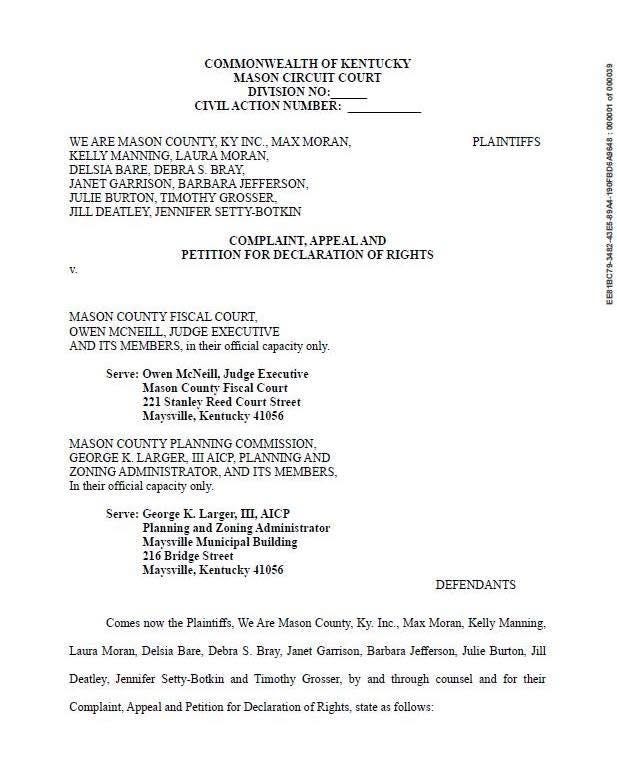
According to a report by Local 12 The group ‘We Are Mason County, Ky. Inc’., along with individual plaintiffs including Max Moran, Kelly Manning, Laura Moran, Delsia Bare, Debra S. Bray, Janet Garrison, Barbara Jefferson, Julie Burton, Timothy Grosser, Jill Deatley, and Jennifer Setty-Botkin, filed a Complaint, Appeal and Petition for Declaration of Rights with the Mason Circuit Court (Civil Division). The lawsuit names Mason County Fiscal Court, Judge Executive Owen McNeill, the Mason County Planning Commission, Planning and Zoning Administrator George K. Larger, III, AICP, and their members in their official capacities as defendants.
The plaintiffs argue that a recently adopted county ordinance regulating data centers conflicts with Mason County’s comprehensive plan. They contend that the current zoning ordinance makes no specific mention of data centers, and that approving such large-scale industrial development without proper planning is unlawful. The suit seeks to invalidate the ordinance or related zoning actions and force reconsideration of the project, potentially resulting in a smaller facility at an alternative location.
The Proposed Project
An undisclosed Fortune 100 AI company has reportedly submitted plans for a massive “hyperscale data center complex” spanning approximately 2,000–2,080 acres of former agricultural land. The project would require rezoning dozens of parcels currently zoned for farming. Local officials have described the prospective tenant as a major global technology firm with extensive data center operations worldwide.
The company has approached multiple landowners with aggressive purchase offers — reportedly up to 10 times the local market value of farmland (roughly $6,000 per acre). Some families received offers exceeding $26 million for portions of their property, with at least one cattle farmer turning down bids as high as $35,000 per acre. Several landowners, including members of the plaintiff group, have publicly rejected the deals, citing a desire to preserve generational farmland.
Community Concerns and Opposition
Opponents, organized under “We Are Mason County,” have raised multiple concerns about the project:
• Loss of prime farmland in a county known for cattle and agricultural production.
• Potential pollution, noise from generators and cooling systems, and increased traffic.
• Strain on local energy infrastructure and higher electricity costs for residents.
• Mismatch with the county’s rural character and long-term comprehensive planning goals.
The group maintains that “zoning without planning is illegal” and that the rushed ordinance does not adequately address these impacts or align with existing land-use policies that emphasize preserving agriculture and rural character.
Public hearings on the rezoning application were held earlier this week, drawing strong community debate. An attorney representing residents had previously signaled the intent to file suit if the project advanced.
County Actions to Date
In late February 2026, the Mason County Fiscal Court approved Ordinance 26-01, which establishes specific regulations for data centers, including setbacks, noise limits, and height restrictions. County officials have described the ordinance as a framework to permit data centers in appropriate industrial zones rather than ban them outright. A rezoning map amendment application for the 2,080-acre site was formally submitted, with further planning commission review ongoing.
Efforts to reach members of the Mason County Planning Commission or Fiscal Court for comment on the newly filed lawsuit were unsuccessful as of this afternoon.
Broader Context
The Mason County dispute reflects a growing national tension between the explosive demand for data centers to support artificial intelligence training and inference — which require enormous amounts of land, power, and water — and local communities wary of industrial transformation in rural areas.
As the lawsuit proceeds in Mason Circuit Court, it could determine whether the hyperscale project moves forward as proposed, gets scaled back, relocated, or faces significant delays. The case highlights how even multimillion-dollar incentives may not overcome deeply held attachments to farmland and small-town character in places like northern Kentucky.
The plaintiffs are represented by counsel, though specific attorneys were not named in the initial filing excerpt. The defendants have not yet publicly responded to the complaint.
This story is developing. Updates will follow as the court case progresses.