

MAYSVILLE, Ky. (Mason County Post) Maysville City Commission candidate Steve Chandler publicly declared his support on Facebook for the controversial proposed data center project in Mason County, framing it as an “excellent opportunity” for the region despite widespread local opposition and ongoing debates over its impacts.
Chandler’s statement comes amid a heated discussion in the community about a secretive, billion-dollar hyperscale data center proposal from an unnamed Fortune 100 company. The project, potentially spanning up to 2,000 acres near areas like Big Pond Pike, has prompted significant pushback from residents concerned about environmental effects, quality of life, farmland loss, and strain on local resources. Some landowners have rejected multimillion-dollar offers to sell their property, with one family turning down nearly $8 million to preserve generational farmland.
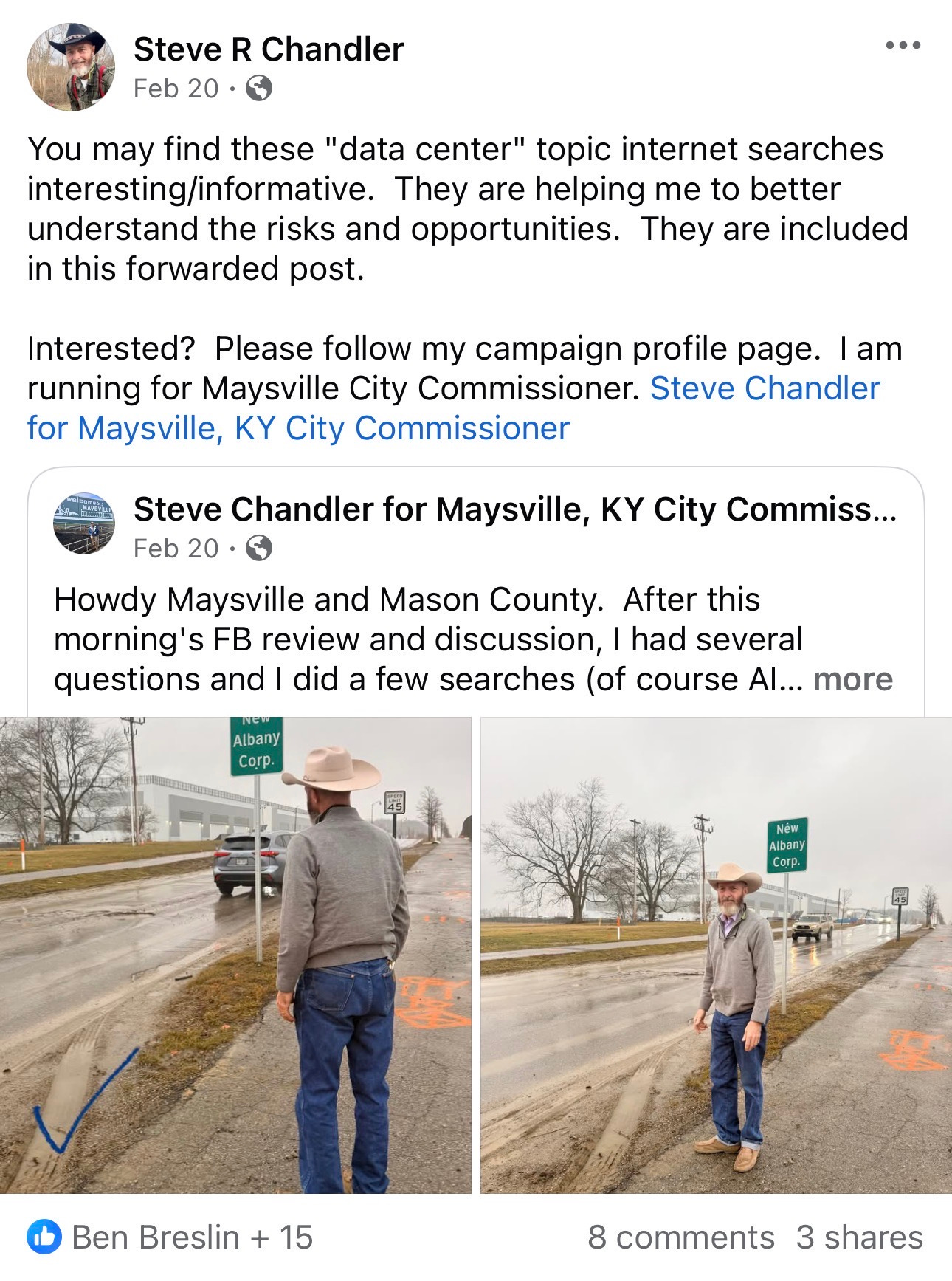
In his post, Chandler emphasized leveraging Mason County’s power generation (via East Kentucky Power Cooperative), water from the Ohio River, land, and workforce to meet national demand for data centers. He argued that the industry is shifting away from densely populated areas, positioning the county as an ideal fit. However, he included caveats: development must be “responsible,” with maximum value negotiated from local resources and all additional power generation and usage costs borne by the data center companies—not ratepayers.
To bolster his position, Chandler shared a list of suggested searches (involving AI assistance) for residents to explore topics like utility service differences between KU and EKP in Maysville, reasons for data center concentrations in places like Loudoun County, Virginia, complaint origins, utility protections against price hikes, GOP-backed guardrails, 2025 tax incentives, and existing data centers on local grids. Critics might see this as an attempt to preempt concerns by directing people toward potentially favorable information, while glossing over documented local anxieties.
The proposal has sparked packed public meetings, zoning amendments under review by the Mason County Joint Planning Commission and Fiscal Court, and calls for transparency. Residents have voiced worries about air quality, increased traffic, perpetual construction noise, discrepancies in promised job numbers (ranging from 50 to 400 permanent positions in various reports), and the risk of higher electric rates despite assurances. Proponents highlight potential tax revenue and jobs, but opponents argue the secrecy and scale could disrupt rural life without guaranteed long-term benefits.
Chandler’s unequivocal endorsement—posted as he campaigns for a seat on the city commission—may alienate voters wary of large-scale industrial development in a historically agricultural and small-town area. While he stresses safeguards, the post arrives as community divisions deepen, with some viewing the project as a boon and others as a threat to the region’s character and environment. As zoning decisions loom, Chandler’s stance positions him firmly on one side of a divisive local issue that shows no signs of easy resolution.